Small ponds can be easy to look after, but their limited water volume means there is less room for neglect. A relatively small amount of uneaten food, decaying leaves, excessive fish waste or evaporated water can represent a much larger change than the same amount would in a large pond.
The aim of small pond maintenance is therefore not constant cleaning. It is to keep the system stable: prevent excessive waste from accumulating, avoid overstocking and overfeeding, keep equipment working properly and notice changes before they become serious.
A well-designed small pond may need surprisingly little work. A badly balanced one can demand attention every week.
Keep a small pond healthy by removing excessive leaves and debris, monitoring fish and water quality, maintaining pumps and filters, controlling feeding and stocking, and preventing plants from becoming either too sparse or excessively overgrown.
Do not completely drain and scrub a healthy pond on a fixed schedule. Routine maintenance should normally correct specific problems while disturbing the pond as little as practical.
Why small ponds need careful maintenance
A small pond is not simply a large pond with less water.
Small and particularly shallow ponds can react quickly to changes in weather and management. Sun can warm shallow water rapidly, evaporation can noticeably lower the water level and a modest amount of decomposing material can represent a significant organic load.
This becomes particularly important where fish are present. Fish consume oxygen and produce waste, while bacteria and other organisms also consume oxygen as organic material decomposes.
For this reason, the most useful approach is preventative maintenance rather than waiting until the water smells, fish behave abnormally or the bottom is covered by a thick layer of sludge.
Larger pond
A larger volume of water generally provides more capacity to absorb small day-to-day changes in waste input, temperature and water level.
Small pond
Limited water volume makes sensible stocking, feeding and routine observation especially important.
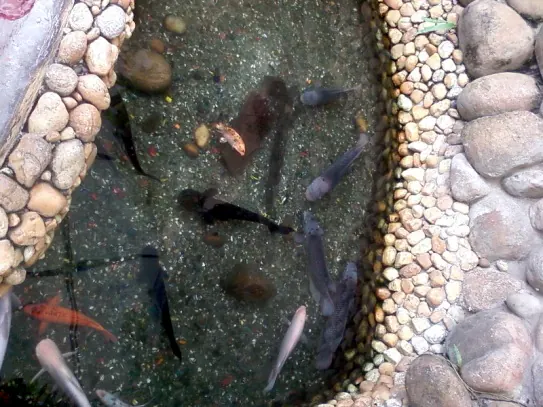
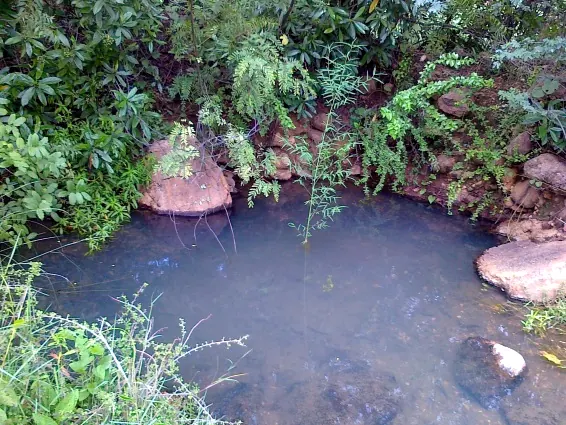
How to keep a small pond clean
Keeping a pond clean does not mean making it sterile.
A healthy garden pond naturally contains microorganisms, algae, plant material and some sediment. Maintenance is needed when material accumulates faster than the pond can process it or when it begins interfering with water quality, equipment or the appearance of the pond.
The most useful routine jobs are:
- remove fallen leaves before they decompose;
- cut back dead or dying aquatic plant material;
- remove excessive blanket weed manually where practical;
- clean mechanical filter material when it becomes clogged;
- remove excessive sludge from obvious collection areas;
- check that water can move freely through pumps and pipework;
- avoid allowing uneaten fish food to accumulate.
The cleaner you can keep material before it decomposes, the less work the pond normally requires later.
Do small ponds need to be completely cleaned?
Not as routine maintenance.
There is no reason to completely drain and scrub a healthy pond simply because a particular number of months or years has passed.
Most maintenance can be performed selectively. Remove accumulated debris, maintain the equipment, trim plants and correct water-quality problems without dismantling the entire pond ecosystem.
A complete drain may occasionally be justified for work such as:
- repairing a liner or structure;
- major redesign;
- removing an extreme accumulation that cannot be managed in place;
- dealing with another specific problem that requires the pond to be empty.
That is different from routinely draining a pond as part of an arbitrary cleaning schedule.
Maintenance should remove excessive waste and keep the system working. The objective is not to turn an established pond back into a newly installed sterile container.
How often should you clean a small pond?
Use the condition of the pond rather than a fixed calendar.
A pond beneath deciduous trees may require frequent leaf removal during autumn but little bottom cleaning during the rest of the year. A heavily stocked fish pond may require more filter maintenance, while a lightly stocked planted pond may require very little mechanical cleaning.
Regular small jobs are usually preferable to allowing a large maintenance backlog to develop.
Check a small pond regularly
The most valuable maintenance tool is observation.
Whenever you visit the pond, look for changes such as:
- fish behaving differently from normal;
- fish gasping or gathering unusually around moving water;
- a sudden change in water clarity or colour;
- an unusual smell;
- a pump producing less flow than normal;
- rapid accumulation of leaves or sludge;
- plants dying back or becoming excessively dominant;
- a water level falling faster than expected.
A change from normal is often more informative than whether the pond looks exactly like somebody else's pond.
Water quality in a small fish pond
If fish are present, water quality becomes one of the most important parts of maintenance.
Important parameters include ammonia, nitrite, pH and water temperature. Testing becomes particularly useful when fish appear stressed, after increasing the fish population, following major maintenance or whenever the pond behaves differently from normal.
Ammonia and nitrite should not be accepted as normal consequences of keeping fish. Detectable levels indicate that waste production and biological processing are no longer adequately balanced.
See our complete guide to fish pond water quality for more information.
Why temperature matters more in a small pond
Small shallow ponds can heat considerably in direct summer sun.
This matters because warm water holds less dissolved oxygen while fish, microorganisms and decomposing organic material continue to consume oxygen. Hot weather can therefore create difficult conditions even when the pond looked completely normal during cooler weather.
Shade from suitable planting can help reduce direct solar heating, but avoid turning the pond into a completely enclosed mass of vegetation.
During hot weather:
- watch fish behaviour closely;
- make sure pumps and aeration are operating normally;
- avoid excessive feeding;
- remove large amounts of decomposing organic material;
- monitor water level and temperature.
Does a small pond need a pump?
Not every small garden pond needs a pump.
A lightly stocked or fishless pond with abundant plants may function without continuous mechanical circulation. A more intensively stocked ornamental fish pond is more likely to benefit from circulation, filtration and possibly additional aeration.
The answer therefore depends on what the pond contains and what the equipment is expected to achieve.
A pump may be used to:
- move water through a filter;
- operate a waterfall or fountain;
- increase circulation;
- supply water to additional equipment.
Small pond pump maintenance
A noticeable reduction in flow is often the first sign that a pump or its surrounding pre-filter needs attention.
Before assuming that the pump has failed, check for:
- leaves or blanket weed around the intake;
- a clogged pre-filter or foam;
- debris around the impeller;
- blocked or kinked pipework;
- an obstructed waterfall or return;
- a water level that has fallen below the required intake depth.
Disconnect electrical equipment safely before opening or cleaning it, and follow the manufacturer's instructions for accessing the impeller or internal parts.
Do not wait for the pump to stop completely. Learning the normal flow of the system makes it easier to notice deterioration early.
Small pond filtration
A small pond does not automatically need a tiny filter.
Filter capacity needs to reflect the waste load generated by the fish and feeding regime, not simply the physical dimensions of the pond.
Mechanical filtration traps particles and therefore needs periodic cleaning. Biological filtration provides surfaces for microorganisms involved in processing fish waste.
If a filter clogs unusually quickly, repeatedly cleaning it may treat only the symptom. Investigate whether the pond is overstocked, overfed or receiving large quantities of external debris.
See our guide to fish pond filtration.
Do not overstock a small fish pond
One of the easiest ways to make a small pond difficult to maintain is to put too many fish into it.
More fish mean more respiration, more food and more waste. Fish also grow, so a population that appears reasonable when the animals are small can become unsuitable as they mature.
Do not choose a stocking level solely by counting how many small fish physically fit into the pond.
Consider:
- adult fish size;
- total water volume;
- surface area;
- filtration;
- aeration;
- feeding level;
- summer water temperature.
See our guide to stocking a fish pond.
Feeding fish in a small pond
Overfeeding has a particularly obvious effect where the water volume and filter capacity are limited.
Food that is not eaten becomes decomposing organic material. Food that is eaten later becomes fish waste. Either way, excessive feeding increases the load that the pond must process.
Feed controlled amounts appropriate for the fish, temperature and conditions, and remove obvious uneaten food.
For a complete feeding guide, see how to feed pond fish.
Plants are part of small pond maintenance
Aquatic plants are not only decorative. They use nutrients, provide structure and shelter and can shade part of the water surface.
Small ponds, however, have limited physical space. A plant that would occupy only a small corner of a large pond can dominate a tiny pond surprisingly quickly.
Trim excessive growth, remove dead material before it decomposes and divide or repot plants when they have clearly outgrown their allotted space.
The aim is balance rather than maximising either open water or plant coverage.
See our guide to fish pond plants.
Where a small pond is located affects maintenance
Some maintenance problems begin outside the pond.
A small pond directly beneath a deciduous tree can receive a large amount of leaf litter relative to its volume. A pond positioned where surface runoff enters from the garden may receive soil, nutrients and other contaminants.
If you are still planning the pond, choose a position that reduces unnecessary inputs while still providing suitable conditions for the plants and animals you intend to keep.
For an existing pond, leaf netting during periods of heavy leaf fall or improvements to the surrounding ground can sometimes reduce maintenance substantially.
How to deal with sludge in a small pond
A thin layer of natural sediment is not automatically a reason to empty the pond.
Concentrate on excessive deposits of leaves, decaying vegetation and soft organic sludge, especially in areas where material repeatedly collects.
A pond vacuum can remove selected deposits without completely draining the pond. Manual removal may also be sufficient in a very small pond.
See our guide to pond vacuum cleaners.
Water changes in a small fish pond
Water changes can be useful when water quality requires dilution or as part of normal fish-pond management, but replacing a large proportion of a small pond without a reason can create a major environmental change.
Prefer controlled partial changes where appropriate and match replacement water to the needs of the pond. If your water supply contains substances that must be treated before use with fish, prepare the replacement water accordingly.
Whenever significant water is removed during filter cleaning, vacuuming or other maintenance, remember to account for that removal as part of the day's water change.
Replacing water lost through evaporation restores the water level, but it does not physically remove the waste and dissolved substances that remained in the pond.
Small pond maintenance during summer
Summer is often the period when a small pond deserves the closest observation.
Higher temperatures can increase fish activity and biological processes while reducing the amount of oxygen the water can hold.
During warm periods:
- watch the water temperature;
- keep pumps and aeration working reliably;
- avoid unnecessary heavy feeding;
- remove decomposing material;
- maintain an appropriate amount of shade;
- check the water level more frequently.
If fish gather at the surface and gasp, treat this as a water-quality or oxygen warning rather than normal summer behaviour.
Small pond maintenance during autumn
Autumn maintenance is mostly about preventing today's leaves and dying plants from becoming tomorrow's sludge.
Remove excessive falling leaves, cut back dead plant material as appropriate for the species and reduce feeding as water temperatures and fish activity fall.
A leaf net can be extremely useful where a small pond sits close to deciduous trees.
Small pond maintenance during winter
The correct winter strategy depends on climate, pond depth, fish species and equipment.
Shallow ponds are more vulnerable to freezing and severe winter conditions than deeper water bodies. If fish remain outside through winter, the pond must be suitable for their needs in the local climate.
Do not continue normal warm-season feeding once cold-water fish have become largely inactive, and avoid allowing large quantities of organic material to decompose beneath ice.
Equipment should be operated, moved or shut down according to its design and the winter conditions expected at the pond.
What should you check every week?
A rigid weekly cleaning schedule is unnecessary, but a quick visual inspection is valuable.
Fish
Check behaviour, appetite, swimming and any obvious physical changes.
Water
Notice changes in level, clarity, smell and temperature.
Pump
Make sure the flow looks and sounds normal.
Filter
Check whether mechanical sections are becoming clogged or flow is being restricted.
Plants
Remove dying material and watch for plants beginning to dominate the pond.
Debris
Remove obvious leaves and other material before they sink and decompose.
Common small pond maintenance mistakes
- Assuming a small pond needs almost no maintenance. Less water does not automatically mean fewer water-quality problems.
- Completely draining and scrubbing the pond on a schedule. Correct specific maintenance problems rather than repeatedly resetting a healthy pond.
- Keeping too many fish. Limited water and filtration capacity can quickly be overwhelmed as fish grow.
- Feeding every time the fish approach you. Fish can learn to beg and excess food increases the pond's waste load.
- Ignoring reduced pump flow. A clogged intake, filter or impeller is much easier to deal with before circulation stops completely.
- Allowing leaves to accumulate. Removing them before decomposition is easier than removing the resulting sludge later.
- Treating all algae as a cleaning problem. Persistent algae can indicate excess nutrients, excessive sunlight or another underlying imbalance.
- Replacing evaporated water and calling it a water change. Top-ups restore volume but do not remove accumulated waste.
- Allowing plants to take over the entire pond. Plants are useful, but small ponds have very limited space.
- Waiting until fish show severe distress. Routine observation can reveal circulation and water-quality changes much earlier.
Small pond maintenance checklist
- Observe the fish. Changes in normal behaviour can be an early warning.
- Check pump and filter flow. Reduced circulation often indicates that cleaning is needed.
- Remove obvious debris. Deal with leaves and dead plant material before decomposition.
- Check the water level. Look for normal evaporation as well as unexplained losses.
- Inspect aquatic plants. Remove dying growth and control plants that are becoming excessive.
- Test water when needed. Water tests are particularly valuable after changes or when fish behave abnormally.
- Review feeding and stocking. Many persistent maintenance problems begin with excessive biological load.
Small pond maintenance vs general pond maintenance
The principles are the same in every healthy fish pond: manage waste, maintain stable water quality, keep equipment working and avoid excessive biological load.
The difference is that a small pond gives the keeper less margin for error. That is why frequent observation and small corrective actions are particularly valuable.
For the complete year-round overview, see our main guide to fish pond maintenance.
Small pond maintenance FAQs
How do you maintain a small pond?
Remove excessive debris, maintain pumps and filters, control feeding and stocking, manage aquatic plants and monitor fish and water quality for changes.
How do you keep a small pond clean?
Remove leaves and dead plant material before they decay, clean mechanical filtration when necessary and remove excessive bottom sludge without trying to sterilise the pond.
How often should a small pond be cleaned?
Clean according to actual debris accumulation and equipment condition rather than following a fixed schedule. Small routine jobs usually prevent the need for disruptive major cleaning.
Should I completely drain a small pond to clean it?
Not routinely. Most maintenance can be performed while the pond remains established. Complete draining is better reserved for a specific reason such as structural repair or an unusually severe problem.
Does a small pond need a pump?
Not always. A lightly stocked or fishless planted pond may function without one, while a more intensively stocked fish pond is more likely to require circulation and filtration.
How do I maintain a small pond pump?
Watch for reduced flow and check the intake, pre-filter, pipework and impeller for debris. Disconnect electrical equipment safely and follow the manufacturer's maintenance instructions.
Why does my small pond get dirty so quickly?
Common causes include falling leaves, excessive fish stocking, overfeeding, inadequate mechanical filtration, dying plants and runoff carrying sediment into the pond.
Are small ponds harder to maintain?
They can be. The physical area is smaller, but limited water volume gives less buffering against changes in temperature, waste load and water level.
How do I prevent algae in a small pond?
Control excessive nutrients, avoid overfeeding and overstocking, remove decomposing material and maintain an appropriate balance of aquatic plants and shade.
Can I keep fish in a very small pond?
Fish suitability depends on water volume, depth, temperature, filtration, aeration and the adult size of the species. A pond should not be stocked simply because juvenile fish physically fit into it.