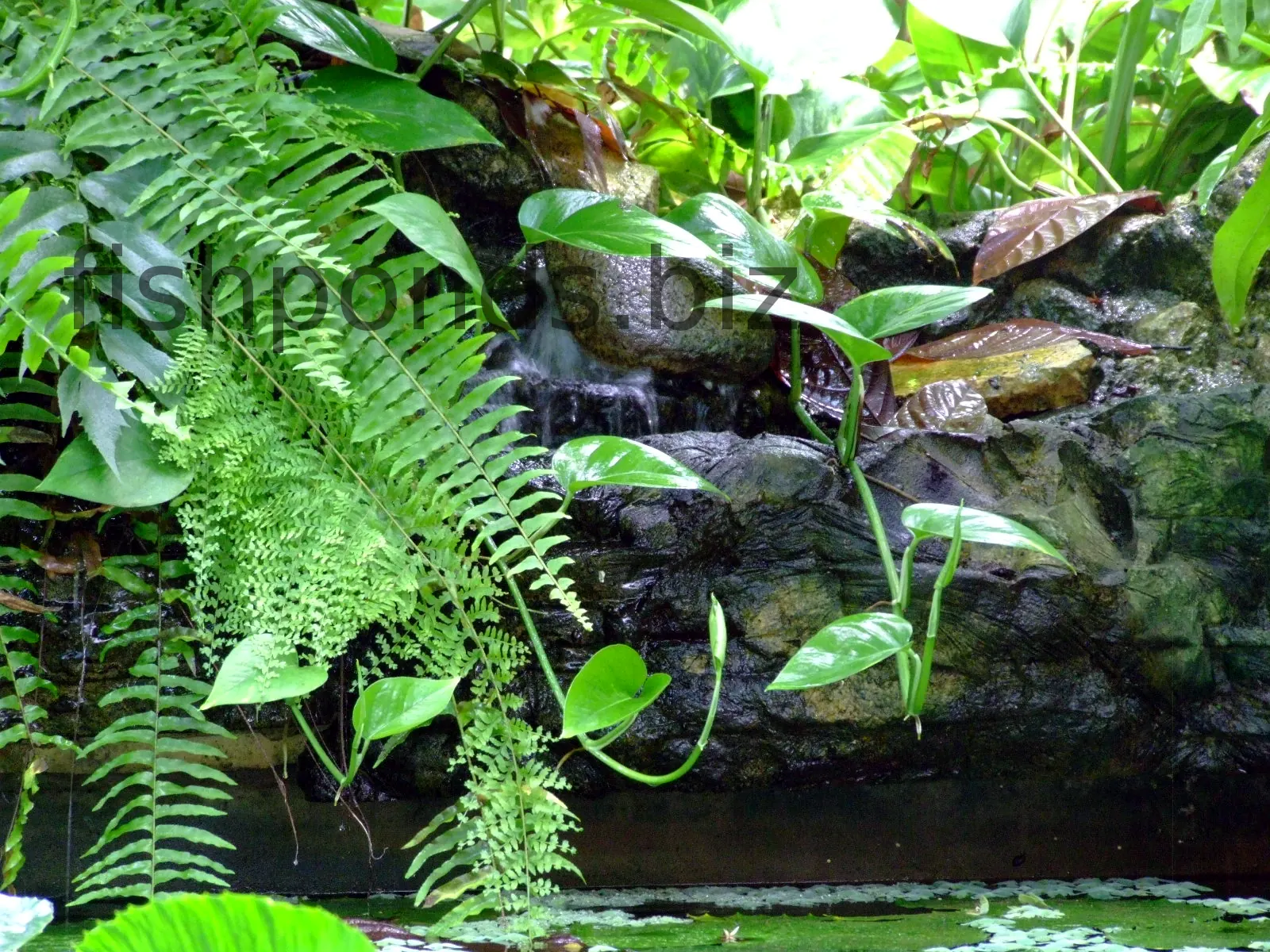
A waterfall can completely change the character of a fish pond. Moving water adds sound and movement, helps the pond blend into the garden and increases interaction between the water and the atmosphere.
A successful pond waterfall, however, is not simply a pile of rocks with a large pump behind it. The width of the spillway, height of the waterfall, pipework, pump performance, liner design and route taken by the water all have to work together.
The best waterfall is therefore not necessarily the largest or most powerful one. It is the waterfall that suits the scale of the pond, delivers the desired flow without wasting energy and returns every litre of pumped water safely to the pond.
Plan the waterfall before choosing the pump. Decide how wide and how powerful you want the flow to look, determine the height through which the water must be lifted and account for resistance from the pipe and fittings.
Then choose a pump that delivers the required flow at the actual head of the completed system — not simply a pump whose maximum flow rating looks large enough on the box.
Build the waterfall on a stable base, use a continuous waterproof course with raised edges, and test the complete feature before hiding the liner and pipework permanently.
What does a waterfall add to a fish pond?
The most obvious benefit is visual. Moving water creates a focal point and can make a constructed pond feel much more closely integrated with the surrounding garden.
The sound is equally important. A shallow stream running over several small drops creates a very different atmosphere from a narrow sheet of water falling into a deep pool.
A waterfall also increases water movement and surface disturbance. This encourages gas exchange between the water and the atmosphere and can contribute to pond aeration.
It should not, however, automatically be assumed that a decorative waterfall provides all of the oxygen required by a heavily stocked pond. Pond depth, water temperature, stocking level, flow pattern and the design of the waterfall all affect the result.
Where should a pond waterfall be positioned?
Position affects both appearance and circulation.
From a visual point of view, the waterfall usually looks most natural where it appears to emerge from slightly higher ground rather than rising abruptly from a completely flat surface.
From a hydraulic point of view, consider where the water is being taken from and where it will return. Returning pumped water at the opposite end of the pond from the pump intake or skimmer can help create useful movement through the pond rather than repeatedly circulating the same small area.
Also consider:
- access to the pump and pipework;
- where electrical equipment can be installed safely;
- whether splashing water can reach paths, walls or timber;
- the route needed for the waterfall liner;
- how easily leaves and debris can be removed;
- whether the finished feature can be viewed from the house or seating area.
How does a fish pond waterfall work?
The basic system is simple.
- Water is taken from the pond. A pond pump draws water from the pond, pump chamber or filtration system.
- The pump pushes water through a pipe. The pipe carries the water to the highest point of the feature.
- Water enters the top of the waterfall. A header pool, waterfall box or spillway distributes the flow.
- Water travels down the waterfall course. Rocks, steps and changes in level control its direction and appearance.
- The water returns to the pond. The entire course must remain inside the waterproof liner system so that no water is lost into the surrounding ground.
What is a waterfall header pool?
A header pool is a small reservoir or distribution area at the top of the waterfall.
Instead of allowing water from the pump pipe to shoot directly down the waterfall, the header allows the incoming water to collect and spread before it passes over the first spillway.
This can produce a more even flow across the width of the waterfall and makes the pipework easier to hide.
Commercial waterfall boxes perform the same general job and may also provide a convenient connection between the pipe, liner and first waterfall drop.
Choose the style of waterfall before choosing the pump
The same spillway can look completely different depending on the amount of water passing over it.
Gentle trickle
Water follows the rock surface closely and produces a quieter, more delicate effect. This can work particularly well beside a small pond or seating area.
Natural waterfall
Enough water passes across the spillway to create a clear, continuous feature without producing an unnecessarily powerful torrent.
Dramatic waterfall
A deeper and faster flow can create more visual impact and sound, but requires greater pump capacity, larger pipework and careful control of splash.
How much flow does a pond waterfall need?
There is no single flow rate that is correct for every waterfall.
The required flow depends mainly on:
- the width of the spillway;
- the desired depth of water over the edge;
- whether the spillway is flat or irregular;
- how many separate drops are present;
- the type and arrangement of rocks;
- the amount of sound and visual movement you want.
As a broad starting point, modern waterfall-pump guidance often uses approximately:
- 9,000–10,000 litres per hour per metre for a relatively gentle flow;
- around 19,000 litres per hour per metre for a medium residential waterfall;
- around 28,000 litres per hour per metre or more for a strong, dramatic flow.
These figures describe the approximate flow that needs to arrive at the waterfall. They are not simply the maximum flow rating that should appear on the pump label.
Suppose the visible waterfall spillway is 30 cm wide and you want a medium flow.
Using approximately 19,000 litres per hour for each metre of spillway:
0.30 × 19,000 = approximately 5,700 litres per hour.
The selected pump therefore needs to deliver roughly that flow after the losses caused by lifting the water and moving it through the pipework have been taken into account.
Why the maximum pump flow rating can be misleading
A pump advertised as producing 6,000 litres per hour will not necessarily deliver 6,000 litres per hour to your waterfall.
Pump flow decreases as the pump has to work against increasing head.
The water must first be lifted vertically from the pond to the top of the waterfall. It must also overcome resistance as it moves through the pipe, bends, valves and other fittings.
This is why pump manufacturers provide performance curves or tables showing the flow delivered at different head heights.
What is total dynamic head?
For practical pond-waterfall design, total dynamic head can be thought of as:
vertical head + friction losses in the plumbing.
Vertical head is the height difference between the relevant pond water level and the highest point to which the pump must deliver the water.
Friction losses come from:
- the length of the pipe;
- the internal diameter of the pipe;
- the rate at which water is moving through it;
- bends and elbows;
- valves and restrictions;
- other fittings in the water path.
A long narrow pipe containing several sharp bends can therefore reduce waterfall performance considerably more than a short, generously sized pipe.
How to choose the right waterfall pump
Choose the pump only after you know approximately how much water you want at the spillway and the head against which the pump will operate.
A practical sequence is:
- Measure the visible spillway width. Ignore decorative rocks outside the part that will actually carry water.
- Choose the visual flow. Decide whether you want a trickle, a normal waterfall or a powerful flow.
- Calculate the approximate required flow. This tells you how much water must reach the top of the feature.
- Measure the vertical lift. Measure from the pond water level to the highest discharge point.
- Account for the plumbing. Long runs, small pipe and numerous fittings increase resistance.
- Read the pump performance curve. Find a pump that still delivers the required flow at the expected total head.
- Compare energy consumption. A pond pump may operate for thousands of hours each year, so wattage matters.
Do not undersize the pipe
A powerful pump connected to unnecessarily narrow plumbing wastes part of its performance overcoming friction.
If the required flow is high, using a larger pipe can substantially reduce resistance and allow the pump to operate more efficiently.
Follow the pump manufacturer's recommended pipe diameter for the intended flow rather than reducing the pipe simply because a smaller size is easier to hide.
How high should a pond waterfall be?
There is no ideal waterfall height for every pond.
A low waterfall can look completely natural beside a small garden pond, while a large pond may visually support a much larger feature.
Increasing the height has several consequences:
- the pump must work against greater vertical head;
- the falling water can become louder;
- splash losses can increase;
- the structure supporting the waterfall becomes more substantial;
- the feature can begin to look out of scale with the pond.
For many garden ponds, several modest drops look more convincing than one unnaturally tall vertical fall.
Single drop, cascade or trickle waterfall?
Single drop
Water crosses one defined spillway and drops directly into the pond or a receiving pool. It can create a clean architectural appearance.
Cascade
Several smaller levels divide the total height. Cascades create visual complexity and can look more natural when built into a slope.
Trickle waterfall
A lower flow follows rock surfaces and shallow channels. This can create a subtle feature with less splash and lower pump demand.
How to build a fish pond waterfall
- Choose the position and final height. Check the view, slope, pipe route and maintenance access before moving soil or stone.
- Build a stable foundation. Soil beneath large stones or masonry must be properly supported and compacted so that the finished waterfall does not settle unevenly.
- Create the upper distribution area. Install the header pool, waterfall box or other structure that receives water from the pump.
- Install the waterproof course. Flexible liner, an appropriate preformed system or another fish-safe permanent waterproofing method can be used.
- Keep the sides higher than the flowing water. The waterproof layer must rise sufficiently at both sides to prevent water escaping into the surrounding soil.
- Install the pipework. Avoid unnecessary restrictions and sharp bends and leave important connections accessible where possible.
- Place the main structural rocks. Make sure every heavy stone is stable before adding decorative smaller pieces.
- Create the spillways. Direct the water towards the centre of the waterproof course rather than towards exposed liner edges.
- Run a full-flow test. Test the waterfall before permanently hiding the liner and pipework.
- Finish the edges. Once you know that the water remains inside the system, disguise the liner naturally with rock, gravel and suitable planting.
Flexible liner waterfalls
Flexible pond liner is one of the most adaptable ways to waterproof a natural-style waterfall or stream.
The liner should form a continuous waterproof path beneath the entire stream and waterfall. Its edges must remain above the maximum flowing water level, including places where rocks redirect or temporarily restrict the flow.
Avoid stretching liner tightly over sharp stones. Provide suitable protection beneath it and leave enough material to accommodate contours and settlement.
The visible liner can then be disguised with stones and gravel once the flow has been tested.
Flexible liner
Best for natural-looking streams and cascades with irregular shapes.
Preformed system
Provides a predictable spillway or waterfall course with less shaping work.
Concrete or masonry
Well suited to architectural and raised ponds when properly waterproofed.
Preformed waterfall units and waterfall boxes
Preformed spillways and waterfall boxes can simplify construction because the shape of the upper water distribution area is already defined.
They are particularly useful when you want a predictable sheet of water or need an easy connection between the supply pipe and the waterfall liner.
They can still be disguised with rock and planting so that only the water outlet remains visible.
Concrete and masonry waterfalls
Concrete and masonry can be useful for permanent architectural waterfalls, particularly around raised ponds.
Do not assume that ordinary concrete or masonry alone provides the finished fish-safe waterproof surface.
Use a waterproofing system intended for permanent immersion and suitable for pond or aquatic use, and follow the manufacturer's preparation and curing instructions before allowing the water to circulate back to a pond containing fish.
How to stop a pond waterfall leaking
Many apparent waterfall "leaks" are not holes in the liner at all.
Water often escapes because it has found a route over the edge of the waterproof course.
Common causes include:
- liner edges positioned too low;
- a rock diverting water sideways;
- water wicking through soil, gravel or moss at the edge;
- excessive splash;
- a settled stone changing the direction of flow;
- a plumbing connection leaking behind the waterfall;
- an insufficient overlap between waterproof sections.
If the pond level falls only while the waterfall is operating, inspect the entire waterfall course and pipework before assuming that the main pond liner is leaking.
Test the waterfall before hiding the liner
This simple step can save a great deal of work.
Run the pump at the intended operating flow and inspect every edge, drop and connection.
Then deliberately vary the flow if the pump can be adjusted. A waterfall that is safe at a gentle trickle may overflow an edge when the pump is opened fully.
Only after the water path is proven should the final liner edges and plumbing be permanently disguised.
How to make a pond waterfall look natural
Natural waterfalls rarely resemble a perfectly symmetrical staircase of identical rocks.
Vary the width and height of individual drops and use larger structural stones to define the route of the water.
Try to make the waterfall appear connected to the surrounding landscape. Rocks used around the pond and waterfall should look as though they belong to the same geology rather than appearing as two unrelated decorative materials.
Also avoid creating a visible mound of soil with stones stuck to the front. Extend rock and planting around the sides so that the elevation appears to continue naturally into the garden.
How to make a pond waterfall quieter
Waterfall sound depends on much more than pump size.
If the finished feature is too loud:
- reduce the flow if the pump allows it;
- reduce the height of free-falling water;
- allow water to follow a sloping rock surface;
- divide one large drop into several smaller drops;
- change the receiving area so that water does not fall directly into a deep open pool.
A broad shallow flow over stone generally produces a softer sound than the same volume of water falling freely through the air.
Waterfalls for small fish ponds
A small pond does not need a miniature hydroelectric station.
A narrow spillway or shallow trickling stream can provide movement and sound without overwhelming the scale of the pond.
Keeping the waterfall relatively low also reduces the required head and can allow a smaller, more economical pump to produce the desired effect.
Be especially careful with splash loss. A small pond contains less water, so the same amount of water splashed outside the liner represents a much larger proportion of its total volume.
Raised pond waterfalls
A raised pond creates different design possibilities because the waterfall does not have to imitate a natural hillside.
It can instead be integrated deliberately into the wall or structure of the pond.
Examples include:
- a narrow spillway built into masonry;
- a short cascade incorporated into one corner;
- a raised header hidden behind stone facing;
- a formal blade or sheet of water entering the pond.
The waterproof connection between the waterfall and the pond is particularly important. Water should never be allowed to disappear behind facing stone, brickwork or timber.
Waterfalls for koi ponds
Koi ponds can certainly include waterfalls.
A waterfall can contribute to circulation and surface agitation and provide a visually attractive return from the filtration system.
But the requirements of the fish should determine the pond engineering. A decorative waterfall should not be used as an excuse to undersize the filtration, circulation or aeration required by a heavily stocked koi pond.
The waterfall should also return water without creating areas where fish can become trapped or repeatedly forced against hard structures.
Does a waterfall oxygenate a fish pond?
A waterfall can contribute to aeration because it increases water movement and contact between water and air.
How much benefit it provides depends on the design. A waterfall that produces substantial surface movement can be useful, while a very small decorative trickle may contribute relatively little to the oxygen requirement of a large or heavily stocked pond.
If fish are showing signs of oxygen stress, do not assume that the presence of a waterfall means dissolved oxygen must be adequate.
A dedicated pond aerator can provide a more predictable source of aeration where the fish load or pond conditions require it.
Can a waterfall replace an air pump?
Sometimes a waterfall provides enough circulation and surface agitation for a lightly stocked ornamental pond, but there is no universal rule that makes an air pump unnecessary whenever a waterfall is present.
Warm water, heavy stocking, high feeding rates and large biological loads can increase the importance of reliable aeration.
Design the oxygenation strategy around the needs of the pond rather than the appearance of the water feature.
Should a pond waterfall run all the time?
That depends on the role of the waterfall.
If it is the main return from a continuously operating biological filtration system, switching it off can also stop the intended circulation through that system.
If the waterfall is a separate decorative circuit, it may be possible to turn it off when the visual feature is not required provided that the pond still has adequate filtration, circulation and aeration.
The important question is therefore not simply whether the waterfall can be switched off, but what other pond functions stop with it.
What should happen to a waterfall in winter?
There is no universal winter rule because climates and waterfall designs vary enormously.
In mild conditions a waterfall may continue to operate normally. In severe freezing conditions, however, ice can alter the water path and cause water to escape outside the pond.
A long exposed waterfall can also increase heat exchange with cold air.
If you shut down the waterfall for winter, make sure that any filtration, circulation or aeration function previously provided by the system is replaced where necessary.
Common fish pond waterfall mistakes
- Choosing the pump from its maximum flow rating. The pump must deliver the required flow at the actual operating head.
- Using pipework that is too narrow. Excessive plumbing resistance reduces flow and wastes pump performance.
- Making the waterfall too large for the pond. Bigger is not automatically better; scale matters.
- Building the waterproof edges too low. Water will eventually find the lowest route out of the waterfall course.
- Hiding everything before testing the flow. Run the waterfall first and inspect every edge and connection.
- Ignoring splash loss. Even a leak-free liner cannot recover water that repeatedly lands outside it.
- Balancing heavy rocks on unstable soil. Structural stones and masonry need a stable foundation.
- Creating inaccessible plumbing. Pumps, valves and important connections will eventually require maintenance.
- Assuming a waterfall replaces all aeration. The aeration requirements of the fish pond must be considered separately.
- Ignoring electricity consumption. A pump running continuously can operate for thousands of hours each year.
Fish pond waterfall FAQs
Can I add a waterfall to an existing fish pond?
Yes. A waterfall can be added later if there is a suitable location for the structure, waterproof connection, pipework and pump. The return water must remain completely inside the pond liner system.
How powerful should a waterfall pump be?
Size the pump according to the required flow at the spillway and the total head of the system. Do not select it from the maximum zero-head flow rating alone.
Does a pond waterfall need a separate pump?
Not necessarily. A waterfall can sometimes be used as the return from the main filtration system. In other designs a dedicated waterfall pump gives independent control of the feature.
Does a waterfall oxygenate a fish pond?
It can improve gas exchange by creating water movement and surface disturbance. The amount of aeration depends on the design and should not automatically be assumed sufficient for a heavily stocked pond.
Can koi ponds have waterfalls?
Yes. Waterfalls can provide an attractive filtration return and contribute to circulation and surface movement, provided the overall filtration and aeration system is appropriate for the koi load.
How do I stop a pond waterfall leaking?
Check for water passing over low liner edges, being diverted by rocks, splashing outside the waterproof course or leaking from plumbing connections. Many waterfall losses are edge or flow problems rather than holes in the liner.
How wide should a pond waterfall be?
Choose a width that suits the scale of the pond and the flow you want. A wider spillway requires substantially more water to maintain the same apparent depth of flow.
Can I build a waterfall on a raised pond?
Yes. Raised ponds are particularly suitable for formal spillways or waterfalls integrated into the wall. Pay careful attention to the waterproof connection between the feature and the pond.
How can I make my waterfall quieter?
Reduce the flow or free-fall height, use several smaller drops instead of one large fall, or allow water to run across sloping rock rather than falling directly into deep water.
Should a fish pond waterfall run 24 hours a day?
If the waterfall is part of the pond's main filtration or circulation system, continuous operation may be important. A separate decorative waterfall can sometimes be switched off if adequate filtration, circulation and aeration continue without it.